

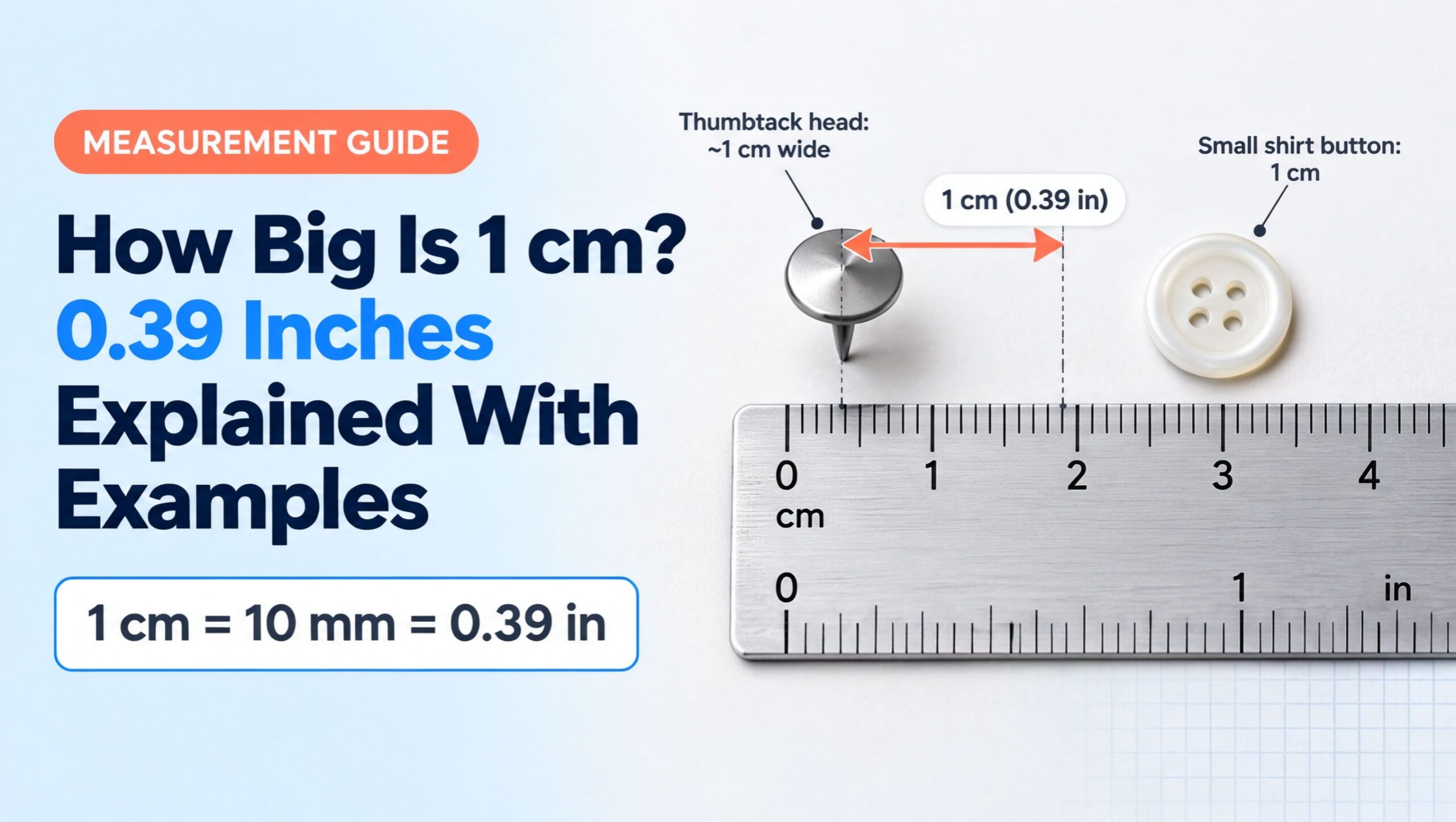
One centimeter is a small unit of length, but it appears in many everyday objects. If you have ever wondered, “How big is 1 cm?” the simplest answer is that 1 centimeter equals 0.39 inches. It is slightly less than half an inch.
A centimeter is part of the metric system. It is commonly used to measure small objects, distances, thicknesses, and dimensions. Understanding its size can help when you do not have a ruler nearby.
One centimeter can be difficult to imagine from a number alone. Real-life comparisons make it much easier. A small fingernail width, a pencil thickness, or a tiny bead can help you picture the size.
| Measurement | Equivalent |
| 1 centimeter | 1 cm |
| Inches | 0.39 inches |
| Millimeters | 10 mm |
| Meters | 0.01 m |
| Feet | 0.0328 ft |
| Yards | 0.0109 yd |
So, when someone asks how big 1 cm is, think of a small length that is just under half an inch.
15 Common Everyday Things That Are About 1 cm Big
Many familiar objects have a dimension close to 1 cm. They are not always exactly 1 cm because manufactured products vary in size.
These comparisons are useful because they give your eyes and hands a practical reference. You can use them to estimate small measurements without immediately reaching for a measuring tool.
Some useful examples include:
- Fingernail width
- Standard pencil thickness
- Stapler pin length
- Small eraser thickness
- Shirt button diameter
- USB port height
- Pen cap thickness
- Coin thickness
- House key thickness
- Lip balm stick diameter
- Charging cable thickness
- Jewelry bead size
- Toothpaste tube opening
- Dice dot size
- Paper clip width
These examples should be treated as approximate comparisons, not exact measurements. Different brands, designs, and materials can change the dimensions.
1 cm in Different Units
Knowing conversions makes 1 cm easier to understand. The most important conversion is that 1 cm equals 0.3937 inches, which is normally rounded to 0.39 inches.
One centimeter also equals 10 millimeters. This makes centimeters useful when measuring objects that are too small for meters but larger than tiny fractions of a millimeter.
| Unit | 1 cm equals |
| Millimeters | 10 mm |
| Inches | 0.3937 in |
| Meters | 0.01 m |
| Feet | 0.0328 ft |
| Yards | 0.0109 yd |
For quick everyday use, remembering 1 cm = 10 mm = about 0.39 inches is enough.
What Does 1 cm Look Like?
One centimeter looks quite small. It is less than half the width of a standard inch. If you look at a typical ruler, the distance between the 0 and 1 centimeter marks represents exactly 1 cm.
Imagine dividing an inch into several small sections. One centimeter would cover a little less than half of that inch. This makes it easier to visualize when comparing metric and imperial measurements.
You can also picture 1 cm as a short distance across a small object. It is large enough to notice but small enough to fit easily on a fingertip.
The exact appearance depends on what you are measuring. A 1 cm length is different from a 1 cm diameter or 1 cm thickness.
Why Understanding 1 cm Matters
Knowing what 1 cm looks like is useful in everyday situations. You may need to estimate the size of an object, check a product dimension, measure craft materials, or understand clothing and accessory measurements.
Small measurement errors can sometimes make a noticeable difference. A difference of just a few centimeters can affect whether an item fits inside a box, case, pocket, or storage space.
Understanding 1 cm also helps when shopping online. Product listings often provide measurements in centimeters. A visual reference helps you decide whether an item will actually be as small or large as you expect.
15 Real-Life Examples of 1 cm (Simple & Daily Use)
Real-life objects are easier to remember than mathematical conversions. The following examples can help you develop a mental image of 1 cm.
| Example | Approximate comparison |
| Fingernail width | Around 1 cm for some nails |
| Pencil thickness | Often close to 1 cm |
| Small button | Around 1 cm |
| Jewelry bead | Some small beads are close to 1 cm |
| Cable thickness | Can approach 1 cm when bundled |
| Key thickness | Some keys are close in thickness |
| Paper clip width | A useful visual comparison |
| Small eraser | Some are about 1 cm thick |
Remember that these objects are only references. Their actual measurements can vary considerably.
1. Fingernail Width
The width of a fingernail can be close to 1 cm, especially for smaller or medium-sized nails. This makes a fingernail a convenient visual reference.
Place your fingernail next to a ruler and compare it with the 1 cm mark. You may find that part of the nail is close to this measurement.
2. Standard Pencil Thickness
A regular wooden pencil often has a diameter close to 1 cm, depending on its shape and manufacturer. Hexagonal pencils can feel slightly different from round pencils.
If you are trying to picture 1 cm, imagining the thickness of a normal pencil can be helpful.
3. Stapler Pin Length
Small stapler pins have short legs that can be close to 1 cm in length. However, staple sizes vary, so not every staple is exactly this length.
This example is useful because staples are familiar objects with very small dimensions.
4. Small Eraser Thickness
A small eraser may have a thickness close to 1 cm. Larger erasers can be much thicker.
If you have a compact pencil eraser, compare its thickness with a centimeter ruler mark. It can provide a simple physical reference.
5. Shirt Button Diameter
Some small shirt buttons have a diameter close to 1 cm. Larger buttons may be 1.5 cm, 2 cm, or more.
A small button is therefore a helpful visual comparison, especially when thinking about diameter rather than length.
6. USB Port Height
Some USB-related connectors and ports have dimensions that can approach 1 cm in one direction. The exact measurement depends on the connector type.
It is better to use USB ports only as a rough reference because different USB standards have different physical dimensions.
7. Pen Cap Thickness
The thickness or diameter of a pen cap can sometimes be close to 1 cm. Slim pens may be smaller, while larger pens can be noticeably wider.
A pen is an easy object to use when developing a mental estimate of small measurements.
8. Coin Thickness (Stacked or Edge View)
A single coin may be thinner than 1 cm, but several coins stacked together can quickly reach or exceed 1 cm.
This is useful because it shows how a small measurement can be built from familiar objects. Always remember that coin thickness varies by country and denomination.
9. House Key Thickness
A house key is usually much thinner than 1 cm across its metal body, but certain thicker parts can provide a rough comparison.
The key is better used as a general small-object reference rather than an exact 1 cm measurement.
10. Lip Balm Stick Diameter
Some lip balm containers have a diameter close to 1 cm, while others are wider.
Because lip balm packaging comes in many shapes, use this example only to create a rough visual estimate.
11. Charging Cable Thickness (Bundled)
A single charging cable is usually much thinner than 1 cm. However, several cables bundled together can easily create a thickness around 1 cm.
This demonstrates why measurement descriptions should specify whether they refer to length, width, height, or diameter.
12. Jewelry Bead Size
Small jewelry beads can have diameters close to 1 cm. Bead sizes are often given in millimeters, making centimeter conversion useful.
For example, a 10 mm bead has a diameter of exactly 1 cm.
13. Toothpaste Tube Opening
The opening of a toothpaste tube is generally smaller than 1 cm, but some caps and wider openings may approach this size.
This is another approximate example rather than a universal measurement.
14. Dice Dot Size
The individual dots or markings on a die can provide a small visual comparison. However, the dot itself is normally much smaller than 1 cm.
A standard die is better used to understand how small 1 cm is compared with a complete everyday object.
15. Paper Clip Width
The wire width and overall shape of a paper clip vary. Some dimensions can provide a rough comparison to 1 cm.
A paper clip is useful for understanding small distances because its individual sections are easy to see.
1 cm in Daily Life
One centimeter appears in many areas of daily life. It can describe the thickness of a material, the diameter of a small object, the width of an item, or the distance between two points.
You may see centimeters used for:
- Clothing measurements
- Jewelry sizes
- Product dimensions
- Craft projects
- School projects
- Furniture measurements
- Electronics
- Packaging
- Small household objects
Once you become familiar with 1 cm, other small measurements become easier to estimate.
Visualizing 1 cm Without a Ruler
You can estimate 1 cm without a ruler by using familiar objects. A pencil thickness, small button, or fingernail can provide a rough reference.
Another useful technique is to use your finger. The width of a fingertip can sometimes be several centimeters, so mentally dividing it into smaller sections can help you estimate 1 cm.
You can also remember that 1 cm equals 10 mm. If you can imagine a very small 1 mm section, ten of those sections make 1 cm.
For important measurements, however, estimation should not replace a ruler or measuring tape.
Common Mistakes When Estimating 1 cm
People often confuse centimeters with inches. Since 1 inch is larger than 1 cm, assuming they are nearly the same can create a significant error.
Another common mistake is confusing length with diameter. An object can be 1 cm wide but several centimeters long.
Common mistakes include:
- Confusing centimeters with inches
- Assuming every small object is exactly 1 cm
- Measuring the wrong dimension
- Ignoring thickness
- Relying on visual guesses for precise work
- Forgetting that products vary by brand
For accurate results, always measure the specific object.
1 cm Compared to Other Measurements
Understanding 1 cm becomes easier when you compare it with other units.
| Measurement | Comparison |
| 1 mm | One-tenth of 1 cm |
| 1 cm | Base comparison |
| 10 cm | Ten times 1 cm |
| 1 inch | About 2.54 cm |
| 5 cm | Five times 1 cm |
| 1 meter | 100 cm |
This shows that 1 cm is a relatively small measurement. One meter contains 100 centimeters, while one centimeter contains 10 millimeters.
How 1 cm Is Used in Product Design
Designers use centimeters to describe the dimensions of many products. Small differences can affect how components fit together.
Product packaging may list height, width, and depth in centimeters. Clothing companies may use centimeters for body measurements. Manufacturers can also use metric measurements when designing small parts.
For customers, understanding 1 cm makes product descriptions easier to interpret. It helps you decide whether an item will fit into a specific space.
Importance of Accurate Measurement
Accurate measurement matters whenever size affects function. A small error may not matter when estimating the width of a button, but it can matter greatly when cutting material or designing a component.
Use a ruler for measurements that need precision. Place the starting edge at zero and read the measurement carefully.
For the best result:
- Keep the ruler straight.
- Start from the zero mark.
- Look directly at the measurement.
- Check the measurement twice.
- Use the correct unit.
- Record the result clearly.
Improving Measurement Skills
Measurement becomes easier with practice. Start by comparing familiar objects with known measurements.
You can practice estimating 1 cm, 2 cm, 5 cm, and 10 cm. Then check your guesses with a ruler. Over time, your visual estimates should become more accurate.
Try this simple exercise:
- Choose a small household object.
- Guess its measurement.
- Write down your estimate.
- Measure it with a ruler.
- Compare your estimate with the actual result.
- Repeat with different objects.
This turns measurement into a practical skill rather than something you only learn from a textbook.
FAQs
What is 1 cm in inches?
1 cm equals approximately 0.39 inches. More precisely, it is 0.3937 inches.
Is 1 cm big or small?
1 cm is a small measurement. It is slightly less than half an inch and is commonly used for small objects.
How can I measure 1 cm without a ruler?
You can estimate 1 cm by comparing it with a small fingernail width, pencil thickness, or another familiar object, but a ruler is better for accuracy.
Is 1 cm common in daily life?
Yes. Centimeters are commonly used for product dimensions, clothing, crafts, electronics, packaging, and many small household measurements.
What objects are about 1 cm in size?
Small buttons, pencil thicknesses, some beads, fingernail widths, and certain small packaging dimensions can be close to 1 cm.
How many millimeters are in 1 cm?
There are exactly 10 millimeters in 1 centimeter.
Is 1 cm the same as 1 inch?
No. One inch is larger. 1 inch equals 2.54 cm, while 1 cm equals about 0.39 inches.
Conclusion
So, how big is 1 cm? One centimeter is equal to 10 millimeters and approximately 0.39 inches. It is a small length that is slightly less than half an inch. Because the measurement is so small, familiar objects can make it much easier to visualize.
A fingernail width, pencil thickness, small button, or jewelry bead can help you build a mental picture of 1 cm. These examples are approximate because real objects come in different sizes. For precise work, always use a ruler or another accurate measuring tool.
Understanding 1 cm is useful for shopping, crafts, product dimensions, schoolwork, household tasks, and everyday estimation. Once you become comfortable with this small unit, comparing centimeters with millimeters and inches becomes much easier.
