

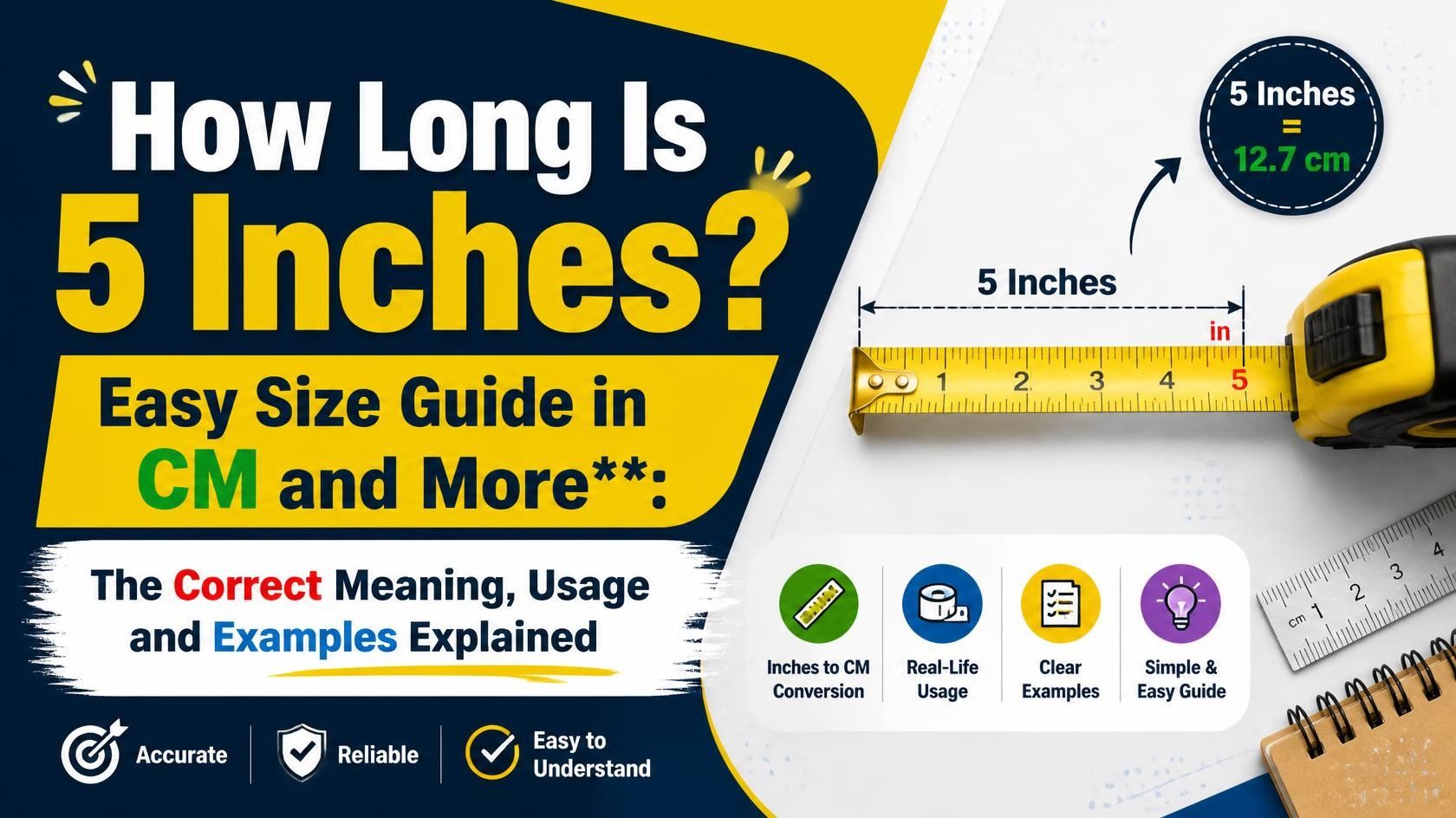
If you are wondering how long 5 inches is, the exact answer is 12.7 centimeters. Five inches is also equal to 127 millimeters. It is a small but useful measurement that appears in many everyday objects.
For a quick visual idea, 5 inches is roughly the length of a small smartphone section, a compact wallet, or a short kitchen tool. The actual size of these objects can vary, so they should only be used as rough comparisons.
Understanding 5 inches can make shopping, crafting, home projects, cooking, and product measurements easier. You can also learn to estimate this length without carrying a ruler everywhere.
| Measurement | Equivalent |
| 5 inches | 12.7 centimeters |
| 5 inches | 127 millimeters |
| 5 inches | 0.4167 feet |
| 5 inches | 0.1389 yards |
| 5 inches | 0.127 meters |
The easiest conversion to remember is 5 inches = 12.7 cm.
15 Common Everyday Things That Are About 5 Inches Long
Many familiar objects can help you understand the size of 5 inches. They do not all measure exactly 5 inches, but their dimensions can be close enough to create a useful mental picture.
Some examples include small containers, household accessories, kitchen tools, and personal items. Their exact measurements depend on the brand and design.
Here are 15 common examples:
- A men’s wallet when viewed across a particular section
- A small drinking glass
- Compact kitchen tongs
- A large curtain ring
- A face wash tube
- The front width of some shoes
- The inner circle of a dinner plate
- A small desk clock
- A mini water bottle
- Kitchen scissors
- A phone stand
- A folded hand towel
- A large spice jar
- A laptop charger head section
- A small gift box
These comparisons are helpful because they connect an abstract measurement to objects you may already recognize.
5 Inches in Different Units
Five inches can be converted into several measurement systems. The most useful conversion is centimeters because centimeters are commonly used outside the United States.
The conversion is simple:
1 inch = 2.54 centimeters
Therefore:
5 × 2.54 = 12.7 centimeters
You can also convert 5 inches into millimeters by multiplying the inch measurement by 25.4. This gives 127 millimeters.
| Unit | 5 Inches |
| Inches | 5 |
| Centimeters | 12.7 cm |
| Millimeters | 127 mm |
| Meters | 0.127 m |
| Feet | 0.4167 ft |
| Yards | 0.1389 yd |
Knowing these conversions is useful when a product description uses a measurement system that you do not normally use.
What Does 5 Inches Look Like?
Five inches is longer than many people initially imagine but still small enough to fit comfortably in one hand. It is about 12.7 cm from one end to the other.
Imagine a line that starts at zero and ends at 5 on a standard inch ruler. That distance is 5 inches. On a metric ruler, the same distance reaches the 12.7 cm mark.
A useful way to visualize it is to compare several objects rather than relying on one item. A small container, compact tool, or short box can give you a better sense of the length.
Keep in mind that an object’s height, width, and depth can all be different. An object may have one dimension close to 5 inches while its other dimensions are much larger or smaller.
Why Understanding 5 Inches Matters
Knowing what 5 inches looks like can help you make better estimates. You may need to judge the size of an item when shopping online or planning a small home project.
Measurements are especially important when an object needs to fit into a specific space. A difference of even one inch can matter when dealing with shelves, boxes, drawers, phone accessories, or furniture.
Understanding this measurement can also help with:
- Online shopping
- DIY projects
- Crafting
- Sewing
- Home organization
- Packaging
- Cooking equipment
- Product comparisons
- School assignments
A basic understanding of measurements saves time and reduces mistakes.
15 Real-Life Examples of 5 Inches (Simple & Daily Use)
The following examples provide practical ways to visualize 5 inches. Remember that these are approximate comparisons, not guaranteed exact measurements.
1. Men’s Wallet Height (Opened Half)
A men’s wallet can provide a familiar reference for a short measurement. Depending on its design, one section or dimension may be close to 5 inches.
Wallet sizes vary considerably. A compact wallet and a larger wallet should not be assumed to have the same dimensions.
2. Small Drinking Glass Height
Some small drinking glasses can be close to 5 inches tall. This makes them an easy household reference.
However, glassware comes in many shapes. A narrow glass may be taller, while a wider tumbler may be shorter.
3. Compact Kitchen Tongs
Small kitchen tongs may have a length close to 5 inches. They are useful for visualizing a short handheld tool.
Full-size cooking tongs are usually much longer, so compact versions are the better comparison.
4. Curtain Ring Diameter (Large Size)
A large curtain ring can sometimes measure several inches across. Some larger designs may approach 5 inches in diameter.
This example shows why it is important to identify which dimension you are measuring. Diameter and circumference are completely different measurements.
5. Face Wash Tube Length
A travel-size or compact face wash tube may be around 5 inches long. Its exact size depends on the packaging.
This is a useful comparison because personal-care products often come in several sizes.
6. Shoe Front Width
The front portion of some shoes can approach 5 inches in width. This varies based on the shoe size and design.
A shoe is not a reliable measuring tool, but it can provide a quick visual estimate.
7. Dinner Plate Inner Circle
Some dinner plates have an inner area that can be several inches across. A particular inner circle may be close to 5 inches.
The complete plate is usually much larger than 5 inches, so this example refers only to the inner section.
8. Small Desk Clock Height
Compact desk clocks can sometimes be close to 5 inches tall or wide. Their shape determines which dimension is closest.
A square clock and a round clock can have very different measurements even when they look similar in size.
9. Mini Water Bottle Height
A small water bottle may have a height around 5 inches. Travel-size containers can be particularly useful as visual references.
Always check the listed dimensions when exact space is important.
10. Kitchen Scissors Length
Small kitchen or utility scissors may have an overall length near 5 inches. Larger scissors can be considerably longer.
This example is useful because scissors are familiar objects with a clearly measurable end-to-end length.
11. Phone Stand Width
A compact phone stand may have a width close to 5 inches. Its folded or unfolded size can be different.
When comparing stands, check whether the listed measurement refers to width, height, or depth.
12. Folded Hand Towel Width
A folded hand towel can have a width of approximately 5 inches depending on how it is folded.
The original towel can be much larger. Folding changes the dimensions without changing the amount of material.
13. Large Spice Jar Height
Some larger spice jars can be around 5 inches tall. They provide a useful kitchen-based comparison.
Smaller spice containers may be considerably shorter, while specialty jars may be taller.
14. Laptop Charger Head Section
The main charger block or a particular section of a laptop charging setup may be close to 5 inches in one dimension.
This is not a universal measurement because chargers differ significantly between brands and models.
15. Small Gift Box Height
A small gift box can easily have a height close to 5 inches. Boxes are especially useful for visualizing measurements because their sides are straight.
A box that is 5 inches tall can still have a much larger width and depth.
5 Inches in Daily Life
Five inches appears in many situations where people need to estimate size. It may describe the height of a container, width of an accessory, depth of a storage item, or length of a small tool.
You may also encounter 5-inch measurements in product specifications. For example, a manufacturer may list the dimensions of a case as 5 inches wide by another measurement in height.
Always look at all dimensions before deciding whether an item will fit. One measurement alone does not describe the complete size of a three-dimensional object.
Visualizing 5 Inches Without a Ruler
You can estimate 5 inches without a ruler by using familiar references. Your own hand can sometimes provide a rough comparison, although hand sizes differ from person to person.
You can also use a standard sheet of paper or another object with known dimensions. Divide or compare the known length mentally to estimate approximately 5 inches.
Useful methods include:
- Compare it with a familiar household object.
- Use a known phone or card dimension as a reference.
- Mark 5 inches on a piece of string for future use.
- Use your hand only as a rough estimate.
- Compare the measurement with a standard ruler when accuracy matters.
For precise work, however, an actual ruler or measuring tape is always better.
Common Mistakes When Estimating 5 Inches
One common mistake is confusing inches with centimeters. Five inches is not 5 centimeters. It is 12.7 centimeters.
Another mistake is measuring the wrong dimension. For example, an item may be 5 inches wide but 8 inches tall. Saying that the entire object is 5 inches long would be misleading.
Other common errors include:
- Guessing based on appearance alone
- Confusing width with height
- Forgetting that product sizes vary
- Measuring packaging instead of the product
- Confusing diameter with circumference
- Rounding too aggressively
When accuracy matters, use a proper measuring tool instead of relying on visual estimation.
5 Inches Compared to Other Sizes
Comparing measurements can make 5 inches easier to understand. Five inches is 2 inches longer than 3 inches and 1 inch shorter than 6 inches.
In centimeters, 5 inches equals 12.7 cm. A 10 cm length is therefore slightly shorter than 5 inches.
| Measurement | Centimeters |
| 2 inches | 5.08 cm |
| 3 inches | 7.62 cm |
| 4 inches | 10.16 cm |
| 5 inches | 12.7 cm |
| 6 inches | 15.24 cm |
| 10 inches | 25.4 cm |
This comparison makes it easier to see how quickly the length changes as you add or remove an inch.
How 5 Inches Is Used in Product Design
Product designers use measurements like 5 inches when developing packaging, accessories, tools, containers, and electronic products. The measurement can affect portability, storage, comfort, and usability.
Designers usually consider several dimensions at once. They may measure height, width, depth, diameter, thickness, and clearance.
A 5-inch dimension may therefore describe only one part of a product. This is why product specifications often contain several measurements rather than one overall size.
Importance of Accurate Measurement
Accurate measurement is important whenever a product needs to fit into a specific space. A small error can cause an item to be too large, too small, or unsuitable for its intended purpose.
For example, if a shelf has only 5 inches of available space, an object measuring 5.2 inches may not fit. This demonstrates why exact measurements are more reliable than visual guesses.
For important measurements, use:
- A ruler for short straight lengths
- A tape measure for larger objects
- A digital caliper for small precision measurements
- A measuring tool with clear unit markings
Improving Measurement Skills
You can become better at estimating 5 inches by practicing with everyday objects. First, measure an object with a ruler. Then look at it without the ruler and make your own estimate.
Repeat this exercise with different objects. Over time, your visual sense of common measurements can improve.
It is also useful to practice converting between inches and centimeters. Remembering a few key values, such as 1 inch = 2.54 cm and 5 inches = 12.7 cm, makes everyday conversions much faster.
FAQs
What is 5 inches in cm?
Five inches equals exactly 12.7 centimeters.
Is 5 inches big or small?
Five inches is generally considered a short length, measuring 12.7 cm. Whether it feels large or small depends on the object being measured.
How can I measure 5 inches without a ruler?
You can compare the length with a familiar object or use a known measurement as a reference. These methods are approximate, not exact.
Is 5 inches common in daily life?
Yes. Measurements close to 5 inches can appear in small containers, tools, accessories, packaging, and household items.
What objects are about 5 inches long?
Small kitchen tools, compact containers, gift boxes, small desk accessories, and some personal-care products can have a dimension close to 5 inches.
How many millimeters are in 5 inches?
Five inches equals 127 millimeters.
How can I convert 5 inches to centimeters?
Multiply 5 by 2.54. The result is 12.7 centimeters.
Conclusion
So, how long is 5 inches? The exact answer is 12.7 centimeters, or 127 millimeters. It is a relatively short measurement that can be found in many everyday products and household objects.
The easiest way to understand 5 inches is to combine exact conversion with real-life comparisons. Small containers, tools, boxes, and accessories can help you develop a mental picture of the length.
Remember that everyday objects are only approximate references. If a measurement needs to be exact, use a ruler, tape measure, or another suitable measuring tool. With regular practice, estimating 5 inches becomes much easier and more natural.
