

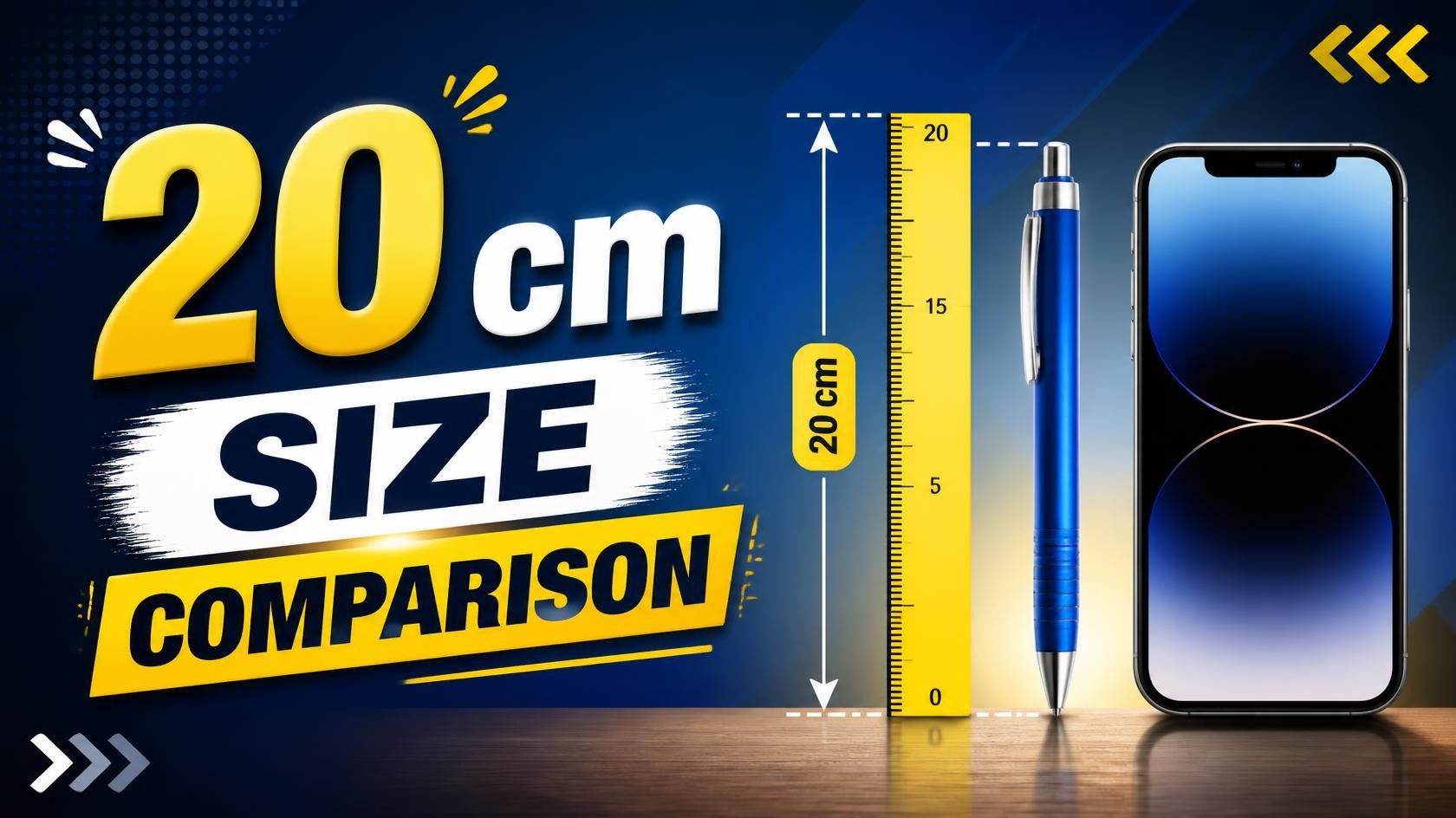
You see 20 cm all the time, even if you never measure it. It shows up on your desk, in your kitchen and on your sofa. This guide shows you what that length looks like in real life.
You will learn the exact conversions, 15 simple examples and easy ways to guess the size without a ruler. Let us start with the basics.
How big is 20 cm? = 7.87 inches
20 cm is equal to 7.87 inches. That is just under 8 inches. It is also 0.2 meters, or 200 millimeters.
Think of it as a little less than the length of a standard sheet of A4 paper’s short side (21 cm). It is a small to medium size. You can hold it easily in one hand.
20 cm in Different Units
Different countries use different units. Here is how 20 cm converts into the most common ones.
| Unit | Value |
| Millimeters (mm) | 200 mm |
| Meters (m) | 0.2 m |
| Inches (in) | 7.87 in |
| Feet (ft) | 0.656 ft |
| Yards (yd) | 0.219 yd |
A quick tip helps here. One inch is 2.54 cm. So divide the centimeters by 2.54 to get inches.
What Does 20 cm Look Like?
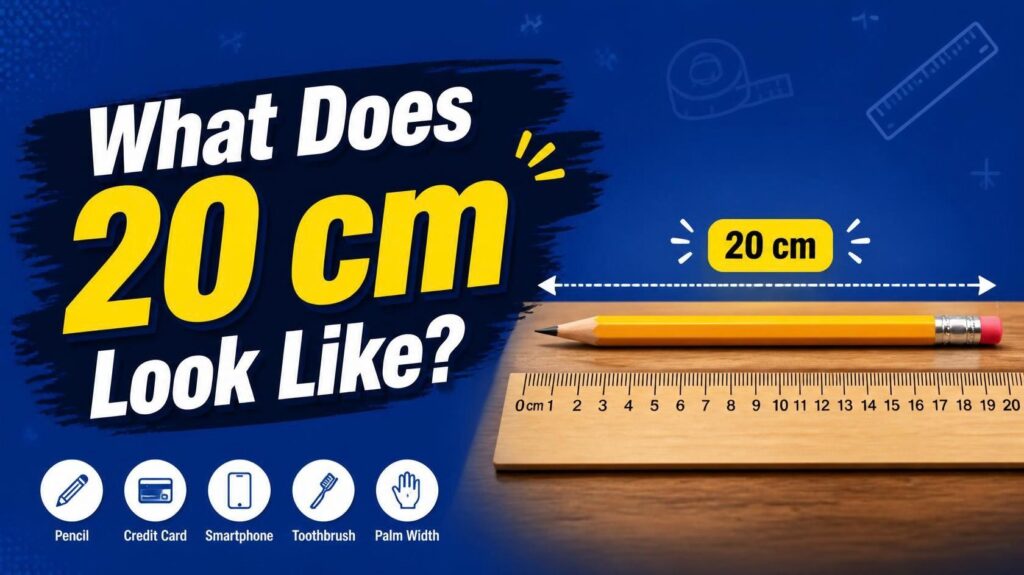
20 cm is about the width of an adult’s open hand, from the thumb tip to the little finger tip. It is also close to the length of a new pencil before sharpening.
It is shorter than a school ruler of 30 cm. It is longer than a smartphone. Most phones are about 15 cm tall, so 20 cm is a little more than a phone and a half thumb.
- A bit shorter than a standard A4 page width
- About two credit cards laid end to end, plus a little extra (each is 8.5 cm)
- Roughly the length of a large adult hand
Why Understanding 20 cm Matters
Small sizes decide whether things fit. A shelf, a bag or a drawer may be just a few centimeters too small. Knowing 20 cm by sight saves time and money.
It also helps when you shop online. Product pages list sizes in centimeters. If you can picture 20 cm, you avoid surprises when the parcel arrives.
Students, crafters, cooks and designers all use this length often. It is a handy mental benchmark.
15 Real-Life Examples of 20 cm (Simple & Daily Use)
Here are 15 objects that measure about 20 cm. Sizes vary by brand, so treat each one as a close estimate.
1. Standard Dinner Plate Diameter
Full dinner plates are usually 25 to 28 cm. Smaller dinner, side and salad plates are often close to 20 cm. They are common in homes, cafes and hotels.
Next time you set the table, notice the smaller plate. It gives you a perfect 20 cm reference.
2. Laptop Sleeve Width
Tablet sleeves and slim mini laptop cases often measure about 20 cm across. They fit small tablets and e-readers well.
Larger laptop sleeves are wider, so check the label before you buy.
3. Large Kitchen Spatula
Many cooking spatulas and turners are about 20 cm in head and neck length. The full handle makes them longer, around 30 to 35 cm.
If you measure only the working end, you will often land near 20 cm.
4. Hardcover Book Height
A compact hardcover book stands close to 20 cm tall. Many novels and notebooks use this size because it feels comfortable in the hands.
Pick one from your shelf and hold a ruler against it. You may be surprised how often it matches.
5. Small Flower Vase Height
Small table vases are often about 20 cm tall. They suit a few stems and sit well on a window sill or coffee table.
This size keeps the view open, so people can see each other across the table.
6. Paper Towel Holder
A standard paper towel roll is about 28 cm wide. Compact kitchen holders and mini rolls are closer to 20 cm. They are popular in small kitchens and bathrooms.
Look at the base or stand. Many are close to this size.
7. Compact Bluetooth Speaker
Portable speakers come in many sizes. Mid-sized models are often about 20 cm long. They are easy to carry in a bag.
That length gives good sound without making the speaker heavy.
8. Small Storage Basket Width
Small woven or plastic baskets are often 20 cm wide. People use them for remote controls, makeup, snacks and craft supplies.
They fit neatly on shelves and inside cubbies.
9. Medium Cutting Board Width
Small to medium cutting boards are often about 20 cm wide. Their length is usually longer, around 30 cm.
This width suits everyday jobs, like slicing fruit, herbs and bread.
10. Desk Photo Frame Height
A common 5 by 7 inch photo frame is about 12.7 by 17.8 cm, but the outer frame often reaches about 20 cm in height. Many desk frames are made with this size in mind.
It is large enough to see clearly and small enough to keep on a work desk.
11. Tissue Box Length (Compact Size)
Compact tissue boxes are often about 20 cm long. Larger family boxes can reach 24 cm or more.
You probably have one within arm’s reach right now.
12. Small Table Clock Width
Many bedside and desk clocks are about 20 cm wide. They are big enough to read quickly and small enough to fit on a nightstand.
Wall clocks often come in a similar size for small rooms and kitchens.
13. Ceramic Serving Bowl Diameter
Medium serving bowls often measure about 20 cm across. They hold salad, pasta or rice for a small family.
Pasta bowls and larger cereal bowls are also close to this size.
14. Office Desk Organizer Length
Many pen holders and small desk trays are around 20 cm long. They keep pens, notes and clips in one tidy place.
This size fits well on a crowded desk without taking over the space.
15. Small Throw Pillow Width
Small decorative cushions can be about 20 cm wide. They are used as accents on beds, chairs and sofas.
Most standard cushions are 40 to 45 cm, so this is a mini size.
Here is a quick summary of all 15 examples.
| No. | Item | Measured Part |
| 1 | Small dinner or side plate | Diameter |
| 2 | Tablet or mini laptop sleeve | Width |
| 3 | Kitchen spatula | Head and neck |
| 4 | Compact hardcover book | Height |
| 5 | Small flower vase | Height |
| 6 | Compact paper towel holder | Width |
| 7 | Bluetooth speaker | Length |
| 8 | Small storage basket | Width |
| 9 | Cutting board | Width |
| 10 | Desk photo frame | Height |
| 11 | Compact tissue box | Length |
| 12 | Table clock | Width |
| 13 | Ceramic serving bowl | Diameter |
| 14 | Desk organizer | Length |
| 15 | Small throw pillow | Width |
20 cm in Daily Life
You meet this length from morning to night. You pour cereal into a 20 cm bowl. You carry a 20 cm notebook to work. You set a small clock of that size beside your bed.
It is a handy human scale. It suits things we pick up, hold and use with one or two hands. That is why so many products settle around this size.
- Kitchen: plates, bowls, spatulas, small boards
- Office: notebooks, organizers, photo frames
- Home: vases, baskets, clocks, small cushions
- Tech: speakers, tablet cases, e-readers
Visualizing 20 cm Without a Ruler
You do not always have a ruler. These tricks help you guess 20 cm fast.
- Use your hand: An adult hand spread wide is often 18 to 22 cm. Measure yours once and remember it.
- Use paper: Fold an A4 sheet along its short side. It is 21 cm, so it is very close.
- Use a banknote or card: Line up two credit cards and add a little extra.
- Use a pencil: A new, unsharpened pencil is about 19 cm long.
Check your hand against a ruler just once. After that, you carry a free measuring tool everywhere.
Common Mistakes When Estimating 20 cm
Most people guess too big or too small. Our eyes are easily tricked by shape and color.
- Thin objects look longer than round ones.
- Tall objects look bigger than wide ones of the same size.
- People mix up centimeters and inches. 20 inches is 50.8 cm, which is much larger.
- Product photos hide the true scale.
- Measuring from the ruler’s edge, not the zero mark, adds error.
Always check the unit on a label. One small letter changes the whole size.
20 cm Compared to Other Measurements
Comparing sizes builds a stronger mental picture. Here is how 20 cm stacks up.
| Length | Compared to 20 cm |
| 10 cm | Half the size |
| 15 cm | Three quarters of the size |
| 30 cm (1 ft) | One and a half times bigger |
| 50 cm | 2.5 times bigger |
| 1 m | Five times bigger |
How 20 cm Is Used in Product Design
Designers pick sizes based on the human body. A hand span of about 20 cm gives them a natural guide. Products near this size feel balanced and easy to control.
Look at cookware, gadgets and storage items. Many follow this rule. It helps products fit standard shelves, bags and drawers. It also lowers packing and shipping costs.
Small decor pieces use the same logic. A 20 cm piece adds style without crowding a room.
Importance of Accurate Measurement
A small error can cause a big problem. A 2 cm gap may stop a part from fitting. In cooking, sewing and building, exact numbers matter.
Accurate measurement also protects your budget. You avoid returns, waste and repeated trips to the store.
- Measure twice before you cut or buy.
- Use a flat, straight ruler or tape.
- Start at zero, not at the edge.
- Write the unit next to every number.
Improving Your Measurement Skills
Good estimation is a skill you can build. Practice a little each day and you will see fast progress.
- Guess the size of an object, then check it with a ruler.
- Learn three body references, such as hand span, thumb width and arm length.
- Keep a small ruler in your bag or drawer.
- Use a measuring app on your phone for quick checks.
- Compare new items to ones you already know.
Within a few weeks, your guesses will land within a centimeter or two.
FAQs
How big is 20 cm in inches?
20 cm is 7.87 inches. That is just under 8 inches.
Is 20 cm considered big?
No, it is a small to medium size. It is about the width of a hand.
How can I estimate 20 cm without a ruler?
Use an open hand span or the short side of an A4 sheet. Both are very close to 20 cm.
Is 20 cm commonly used in daily life?
Yes, very often. Plates, books, bowls and decor items use this size.
What everyday objects are about 20 cm?
Small plates, hardcover books, serving bowls, vases and tissue boxes. Many desk items fit too.
How many millimeters is 20 cm?
20 cm equals 200 millimeters. Multiply centimeters by 10.
How many feet is 20 cm?
20 cm is about 0.66 feet. That is a little over half a foot.
Conclusion: Final Thoughts on 20 cm
20 cm is 7.87 inches, 200 millimeters and about two thirds of a foot. It is a small, friendly size that you meet every day. From plates and books to vases and clocks, it is everywhere around you.
Learn a few simple references, like your hand span and an A4 sheet. Then practice often. With a little effort, you will judge lengths with ease and make smarter choices when you shop, cook, build or design.
