

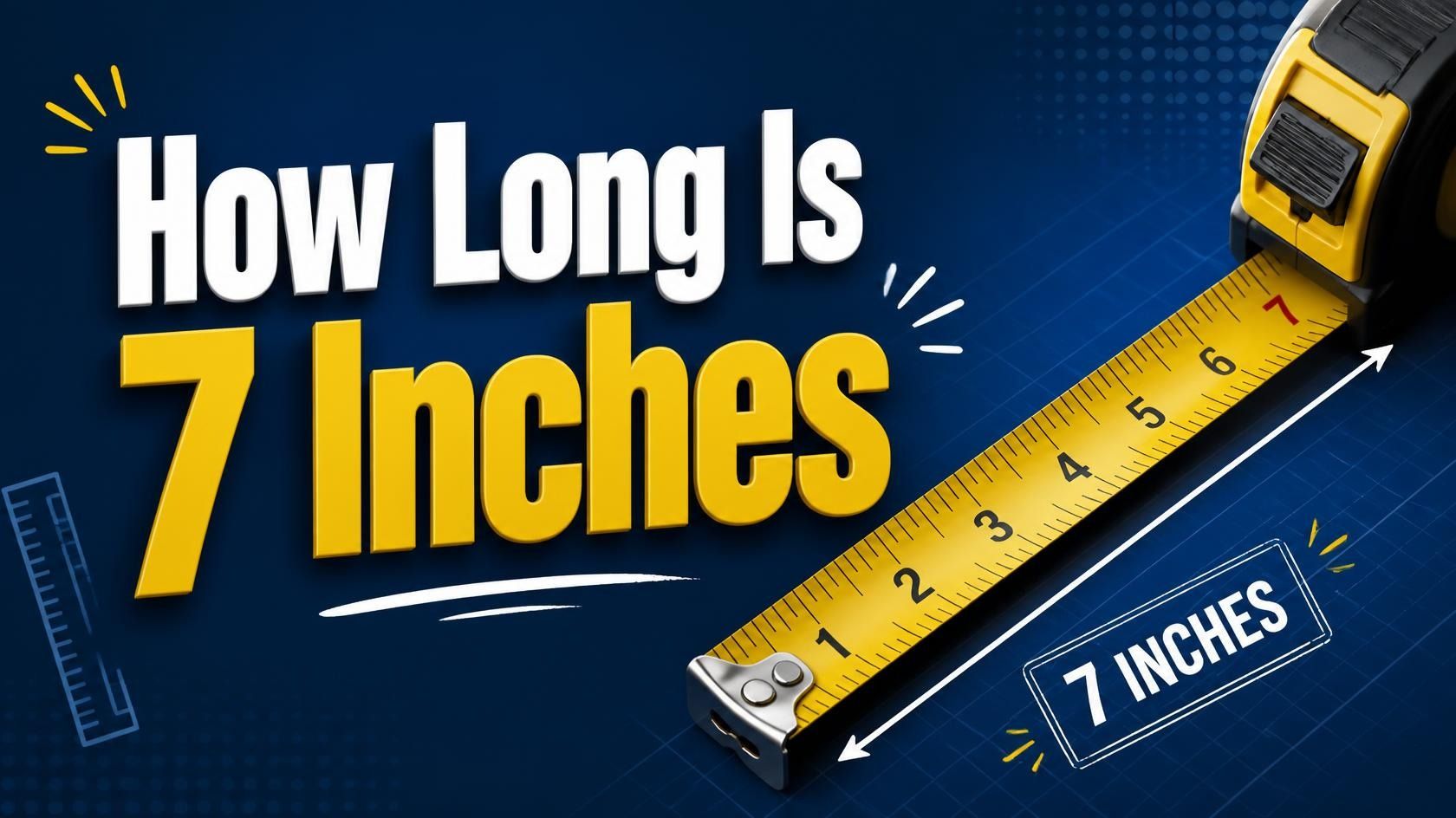
Seven inches is a useful measurement that appears in many everyday objects. You may see it when checking the size of a tablet, book, kitchen tool, bottle, or even a sandwich. But numbers can be difficult to picture when you do not have a ruler nearby.
So, how big is 7 inches in real life? 7 inches equals 17.78 centimeters. That is roughly the length of a large hand span or a medium sized kitchen utensil. Knowing familiar objects that are close to this size can make measurement much easier.
How long is 7 inches?
Seven inches is exactly 17.78 cm. In millimeters, it is 177.8 mm. It is not extremely long, but it is large enough to be noticeable when placed beside common household items.
For a quick visual idea, imagine a standard table fork. Many forks are close to this length, although the exact size depends on the design. A medium kitchen tool, small book, or some tablet accessories can also come close.
Here is a quick conversion table:
| Measurement | Equivalent to 7 Inches |
| Centimeters | 17.78 cm |
| Millimeters | 177.8 mm |
| Feet | 0.583 ft |
| Yards | 0.194 yd |
| Meters | 0.1778 m |
7 Inches in Different Units
Understanding different units makes 7 inches easier to compare. The most common conversion is inches to centimeters because centimeters are widely used outside the United States.
Seven inches equals 17.78 centimeters. It is also equal to 177.8 millimeters. In feet, the measurement is about 0.583 feet.
You do not need to memorize every conversion. Remembering 7 inches = 17.78 cm is enough for most everyday situations.
What Does 7 Inches Look Like?
Seven inches looks roughly like the length of a medium sized kitchen fork. It can also be similar to the width of some notebooks or small serving items.
Your hand can provide another useful reference. For many adults, the distance from the tip of the thumb to the tip of the little finger when the hand is fully stretched can be close to 7 inches. However, hand sizes vary considerably.
Think of 7 inches as being:
- Longer than a typical smartphone screen height in some models
- Around the length of a standard fork
- Close to the width of some books
- Similar to the height of certain small bottles
- About the length of a large hand span
Why Understanding 7 Inches Matters
Knowing what 7 inches looks like can help when shopping online. Product dimensions are often shown in inches, especially on American websites.
It can also help with home projects, cooking, crafts, furniture planning, and school activities. Instead of guessing from a number, you can compare the measurement with something familiar.
Accurate size knowledge is especially useful when a product needs to fit inside a drawer, bag, shelf, case, or storage box.
15 Real-Life Examples of 7 Inches (Simple & Daily Use)
Many ordinary objects can be close to 7 inches. Their actual dimensions can change because manufacturers use different designs and sizes.
The examples below are useful visual references rather than fixed measurements.
| Object | Approximate 7 Inch Comparison |
| Standard table fork | Overall length |
| Hair straightener plate | Plate section |
| Small tablet | Shorter side |
| Kitchen ladle | Handle section |
| Pencil case | Overall length |
| Hand span | Fully stretched |
| Kitchen knife | Medium blade |
| Paperback book | Width |
| Water bottle | Height |
| Tablet keyboard | Width |
| Teen shoe | Length |
| Serving tray | Width |
| Cooling pad | Smaller section |
| Large notebook | Width |
| Large sandwich | Overall length |
1. Standard Table Fork Length
A standard table fork can be close to 7 inches from the handle end to the tips of its prongs.
Place a fork beside a ruler and you will get a quick visual reference. Some dinner forks are shorter or longer, so this is only an approximate comparison.
2. Hair Straightener Plate Length
Some hair straighteners have plates that measure several inches long. Certain compact models may have a plate section close to 7 inches.
The total straightener is usually longer because of the handle and other components.
3. Small Tablet Length
Some compact tablets have one side that comes close to 7 inches. Tablet sizes vary widely, so check the manufacturer’s listed dimensions before buying a case.
A 7 inch measurement can help you understand how compact or portable a device may feel.
4. Kitchen Ladle Handle
A small kitchen ladle can have a handle close to 7 inches. Larger soup ladles are often considerably longer.
A ladle is useful for visualizing the measurement because its long handle makes the size easy to see.
5. Pencil Case Length
Many pencil cases are around 7 inches long. This size can hold several pencils, pens, erasers, and other small supplies.
It is also a helpful comparison when deciding whether a case will fit inside a backpack or desk drawer.
6. Hand Span (Fully Stretched)
For some people, a fully stretched hand can span around 7 inches from the thumb to the little finger.
This is convenient when you do not have a measuring tool. However, hand size differs from person to person, so it should not replace an actual measurement.
7. Kitchen Knife Blade (Medium Size)
A medium kitchen knife can have a blade close to 7 inches. Many chef knives are available in different blade lengths.
Always check the blade measurement separately from the total knife length because the handle adds extra length.
8. Paperback Book Width
Some paperback books can be around 7 inches wide or close to that measurement. Book dimensions vary depending on the publisher and format.
If you are buying a cover or storage box, use the actual dimensions instead of relying on the general 7 inch comparison.
9. Water Bottle Height (Medium Size)
Certain small and medium water bottles can be around 7 inches tall.
Bottle shapes are different, so two bottles holding the same amount of water can have different heights.
10. Tablet Keyboard Width
Compact tablet keyboards may have a width close to 7 inches. These keyboards are designed for portability and easy storage.
Their exact size depends on the number of keys, layout, and device compatibility.
11. Shoe Length (Teen Size)
Some smaller teen shoes can measure close to 7 inches from heel to toe.
Shoe sizing is not the same as measuring foot length directly. A shoe also needs internal space for comfort and movement.
12. Small Serving Tray Width
A compact serving tray may have a width close to 7 inches.
This size can be convenient for carrying a drink, snack, dessert, or small meal. Larger trays can be several inches wider.
13. Laptop Cooling Pad Section
A smaller laptop cooling pad or one of its internal sections may measure around 7 inches.
The full cooling pad is usually larger because it needs to support the laptop and contain its cooling components.
14. Notebook Width (Large Size)
Some larger notebooks can be close to 7 inches wide. This provides enough writing space while remaining portable.
Notebook dimensions vary, so check the product specifications when exact size matters.
15. Sandwich (Large Sub Size)
A large sandwich or sub can reach approximately 7 inches in length.
This is one of the easiest food based comparisons because you can visually compare the sandwich with your hand or a standard kitchen utensil.
7 Inches in Daily Life
Seven inches appears in more places than you might expect. Household products, electronics, stationery, kitchen tools, and food items can all fall near this measurement.
When you start recognizing the size, product descriptions become easier to understand. You can quickly estimate whether something will fit in a particular space.
For everyday estimation, use objects you already know. A fork, pencil case, notebook, or stretched hand can serve as a quick reference.
Visualizing 7 Inches Without a Ruler
You can estimate 7 inches by using familiar objects. The goal is not perfect accuracy. It is to develop a reliable sense of scale.
Try these methods:
- Compare the length with a standard table fork.
- Stretch your hand and compare the thumb to little finger distance.
- Use a pencil case that is close to 7 inches.
- Compare it with a small notebook.
- Use a credit card as a smaller reference and estimate the remaining distance.
- Mark 7 inches on a piece of paper once and keep it as a visual reference.
For accurate work, always use a ruler, measuring tape, or digital measuring tool.
Common Mistakes When Estimating 7 Inches
One common mistake is assuming every familiar object has a standard size. A fork from one manufacturer may be noticeably different from another.
Another mistake is confusing length, width, and height. A product can be 7 inches long but only 3 inches wide.
People also tend to underestimate measurements when judging them from photographs. Product images can make an object look larger or smaller than it really is.
7 Inches Compared to Other Measurements
Comparing 7 inches with nearby measurements can improve your sense of scale.
| Measurement | Size Compared With 7 Inches |
| 1 inch | Much smaller |
| 3 inches | Less than half |
| 5 inches | Noticeably shorter |
| 6 inches | Slightly shorter |
| 7 inches | Reference size |
| 8 inches | Slightly longer |
| 10 inches | Clearly longer |
| 12 inches | About 5 inches longer |
Seven inches sits between the size of many small handheld items and larger household objects.
How 7 Inches Is Used in Product Design
Manufacturers use measurements like 7 inches when designing consumer products. The size may affect portability, comfort, storage, and usability.
For example, a device that is 7 inches wide may fit easily into a small bag. A 7 inch handle may provide enough room for a comfortable grip without making a tool unnecessarily large.
Designers also consider proportions. A product is rarely defined by one measurement alone. Length, width, height, thickness, weight, and shape all matter.
Importance of Accurate Measurement
Accurate measurement prevents mistakes. This matters when ordering furniture, buying electronics, selecting accessories, or completing DIY work.
An object that is only one inch different from your expectation may not fit into a tight space. A case, shelf, drawer, or holder can require very specific dimensions.
For rough comparisons, familiar objects are useful. For purchases and construction, always check the manufacturer’s official dimensions.
Improving Measurement Skills
You can improve your measurement skills through regular practice. Start by guessing the size of everyday objects before checking them with a ruler.
Try estimating the length of a pen, spoon, notebook, phone, or box. Then measure each item and compare your guess with the actual result.
Over time, your brain becomes better at recognizing scale. You will not need a ruler for every simple estimate, although precise tasks should still use proper measuring equipment.
FAQs
What is 7 inches in cm?
7 inches is exactly 17.78 centimeters. It is also 177.8 millimeters.
Is 7 inches big or small?
Seven inches is a medium sized everyday measurement. It is close to the length of many forks and small household items.
How can I measure 7 inches without a ruler?
You can compare 7 inches with a stretched hand, fork, pencil case, or another familiar object. These methods give estimates, not exact results.
Is 7 inches common in daily life?
Yes. Many kitchen tools, stationery items, small devices, and food items can measure around 7 inches.
What objects are about 7 inches long?
A table fork, pencil case, small tablet, medium knife blade, notebook, and large sandwich can be close to 7 inches.
How long is 7 inches in millimeters?
Seven inches equals 177.8 millimeters. This conversion is useful for small product dimensions and technical measurements.
Can I accurately guess 7 inches by hand?
You can make a reasonable estimate with your hand if your hand span is close to 7 inches. For exact measurements, use a ruler or measuring tape.
Conclusion
Understanding 7 inches becomes much easier when you connect the number with objects you see every day. Instead of thinking about an abstract measurement, picture a table fork, pencil case, notebook, small tablet, or stretched hand.
Remember that these objects are only approximate examples. Their actual dimensions can vary by brand, design, and purpose. If exact size matters, check the listed specifications or measure the object directly.
The key conversion is simple: 7 inches equals 17.78 cm. Once you remember that number and practice comparing it with familiar items, you can estimate this measurement much more confidently in everyday situations.
