

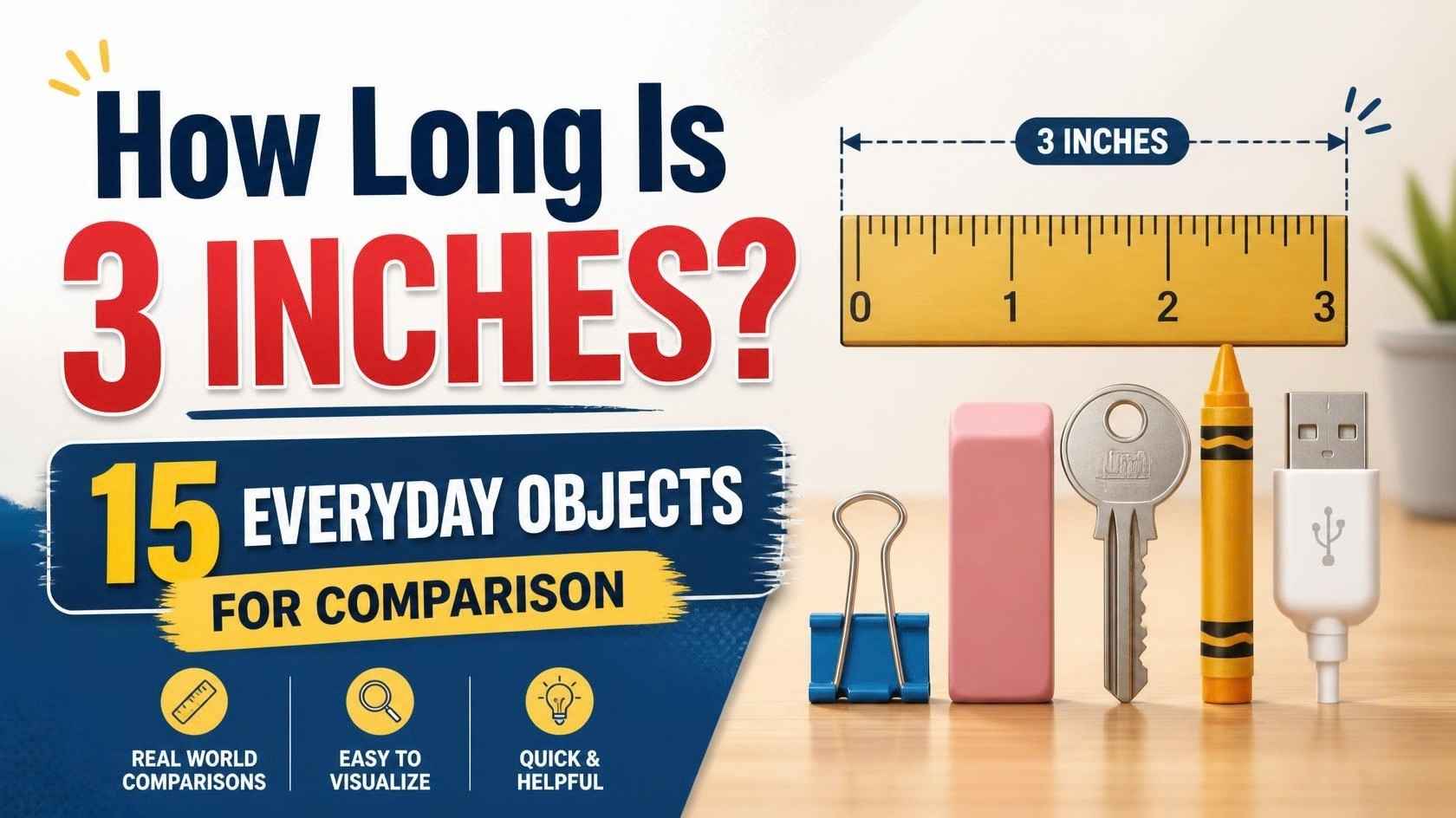
Three inches is equal to 7.62 centimeters (cm). It is a short measurement that you can easily picture using common household items. For example, three inches is close to the width of three fingers placed side by side, a small sticky note, or a compact travel-size product. These examples help you understand the measurement without always needing a ruler.
The inch is a standard unit of length used in the United States and several other countries. Centimeters are part of the metric system, which is widely used around the world. Knowing how to convert inches into centimeters can help you measure objects, compare product sizes, complete DIY projects, and understand online shopping dimensions.
In this guide, you will learn how long three inches is, how it compares with other measurements, and which 15 everyday objects can help you visualize its size. You will also discover simple ways to measure three inches accurately at home.
15 Common Everyday Things That Are About 3 Inches Long
Three inches may seem like a small distance, but it is useful in many everyday situations. You can use familiar objects to estimate this length when a measuring tool is unavailable. Items such as keys, small notes, soap bars, and container lids can provide a helpful visual reference.
However, not every example will measure exactly three inches. Product sizes vary by brand, design, and purpose. The examples below are approximate comparisons rather than fixed measurements. For an accurate result, always check the object’s dimensions with a ruler or measuring tape.
3 Inches in Different Units
Three inches can be expressed in several measurement units. The conversion depends on the unit you want to use. Centimeters and millimeters are common choices for everyday measurements, while feet and yards are useful for larger distances.
The basic conversion is simple. One inch equals 2.54 centimeters exactly. Therefore, multiplying three by 2.54 gives 7.62 centimeters.
| Measurement unit | Equivalent of 3 inches |
| Inches | 3 inches |
| Centimeters | 7.62 cm |
| Millimeters | 76.2 mm |
| Feet | 0.25 feet |
| Yards | 0.0833 yards |
| Meters | 0.0762 m |
These conversions are helpful when reading product descriptions or following instructions. For example, a craft pattern might use inches, while a school project or technical drawing might use centimeters or millimeters.
Remembering that three inches equals 76.2 millimeters can also help when working with small components. You do not need to memorize every conversion. Knowing the relationship between inches and centimeters is enough to calculate many common lengths.
What Does 3 Inches Look Like?
Three inches is about the length of a small everyday object held in your hand. It is longer than a typical large coin and shorter than many standard smartphones. You can visualize it by looking at your fingers, a small packet, or a compact household item.
Imagine a straight line beginning at zero and ending at the three-inch mark on a ruler. That distance is 7.62 centimeters. It is not the size of the entire ruler, only the space between those two points.
Here are a few simple ways to picture three inches:
- Place three fingers next to one another and compare their combined width with a ruler.
- Look at a small sticky note and estimate its width.
- Imagine a line measuring 7.62 centimeters on a sheet of paper.
- Compare the length with a compact key or small personal-care product.
These comparisons are useful for quick estimates. Still, finger widths and household objects differ from person to person and product to product. Treat them as visual guides rather than exact measuring tools.
15 Real-Life Examples of 3 Inches (Simple & Daily Use)
Everyday objects can make measurements easier to understand. You may already have several items near you that are approximately three inches long or wide. The following examples explain how to use these objects as visual references.
1. Three Fingers Width
Three fingers placed side by side can sometimes measure close to three inches across. This depends on the width of your fingers and how closely you position them. For some people, the combined width will be smaller or larger.
To check your estimate, place your fingers together without overlapping them. Compare their total width with a ruler. Once you know your own approximate finger width, you can use it as a quick reference for estimating small distances.
2. Small Sticky Note
Some small sticky notes have a width or height close to three inches. Square notes measuring three inches on each side are also available. They offer a useful way to visualize a short length on a desk or notebook.
Check the package dimensions before using a sticky note as a precise reference. Notes come in many sizes, including smaller squares and larger rectangular sheets. A note that measures three inches across can help you estimate other objects with a similar width.
3. Travel-Size Soap Bar
A compact travel-size soap bar may measure around three inches in length. Its exact size depends on the shape, thickness, and manufacturer. Small soap bars are easy to handle, making them useful for visual comparisons.
Place the soap on a flat surface and compare its longest side with a ruler. Some bars are longer than three inches, while others are shorter. The example works best when you check the actual dimensions rather than relying only on appearance.
4. House Key (Full Length)
A small house key can be a helpful reference for understanding a short measurement. Some keys are close to three inches long when measured from the tip to the far end of the bow, or handle. Other keys are considerably shorter.
Lay the key flat and measure its complete length. Avoid assuming that all house keys have the same dimensions. Their size varies according to the lock design and the type of key.
5. Toothbrush Head
The head of a toothbrush may be around three inches long, although many modern toothbrush heads are shorter. The overall length of the toothbrush is much greater than three inches, so focus only on the bristle head when making this comparison.
You can estimate the toothbrush head’s length by measuring from the top of the bristles to the point where the head joins the neck. This example is useful when comparing oral-care products, but the actual size depends on whether the brush is designed for children or adults.
6. Small Biscuit Packet Width
A small biscuit or snack packet may be about three inches wide. This is particularly possible with compact, individually wrapped snacks. Larger packets can be much wider, so this comparison is not universal.
Place the packet on a table and measure across its widest flat side. Flexible packaging can bend or wrinkle, which may affect the measurement. For a more reliable result, flatten the packet gently without stretching it.
7. Tea Cup Opening
The opening of a small teacup may measure close to three inches across. This refers to the diameter of the cup’s opening, not the distance around its rim. Cup dimensions vary depending on the style and capacity.
To measure it, place a ruler across the center of the opening from one inner edge to the opposite inner edge. A diameter of three inches equals 7.62 centimeters. This comparison can be useful when choosing cups or checking whether a small item will fit inside one.
8. Mobile Charger Adapter
A compact mobile charger adapter may have one side close to three inches long. However, many standard wall chargers are smaller, while some high-power adapters are larger. Their dimensions depend on the charging technology and design.
Measure the adapter’s longest side to see whether it matches three inches. Do not include a cable unless you are measuring the combined length of the adapter and cable. This example is helpful when comparing compact chargers for travel or storage.
9. Small Remote Control Width
A small remote control may be close to three inches wide, particularly if it has a compact design. Most remote controls are longer than they are wide, so the width may be a more useful comparison than the full length.
Measure straight across the remote at its widest point. Some television and streaming-device remotes are narrow, while other models have broader bodies. Checking the dimensions can help you decide whether a remote will fit into a drawer or storage compartment.
10. Mini Notebook Width
A mini notebook may have a width or height close to three inches. Small pocket notebooks come in different shapes, including square and rectangular formats. Some are designed for quick notes, shopping lists, or short reminders.
Measure the cover from one edge to the other. If the notebook is three inches wide, it provides a clear example of this measurement. Keep in mind that the width and height are different dimensions, so identify which side you are measuring.
11. Spoon Handle (Top Part)
The upper section of a spoon handle can be close to three inches long on some designs. This comparison refers only to part of the handle, not the entire spoon. Most ordinary spoons have a total length greater than three inches.
Lay the spoon on a flat surface and measure the section you want to compare. Decorative spoons, teaspoons, and serving spoons come in many shapes and sizes. Use this example as a visual aid rather than a universal measurement.
12. Matchbox Length
A small matchbox may have one side measuring approximately three inches, depending on its design. Many matchboxes are shorter than this, so it is important to check the actual dimensions before using one as a reference.
Measure from one end of the box to the other along its longest side. A matchbox can be useful for visualizing small lengths because its edges are straight. Keep matches away from children and sources of heat when using the box as a measurement example.
13. Small Cream Tube
A travel-size cream tube may have a length close to three inches. This is more likely with certain compact packaging styles, although some tubes are much longer. The cap and container shape can also affect the overall measurement.
Place the tube on a flat surface and measure from its bottom edge to the top of the cap. If you are comparing product sizes while shopping, check the listed dimensions because volume alone does not tell you the package’s exact length.
14. Wallet Card Slot Width
A wallet’s card slot may be around three inches wide. Many wallet compartments are designed to hold standard payment cards, which are approximately 3.37 inches wide. Therefore, the actual slot opening can be close to three inches but is not necessarily exactly that size.
Measure the opening from one side to the other without stretching the material. This example shows how a measurement can be close to three inches while still differing slightly. For a better fit, compare the slot with the card you intend to carry.
15. Small Kitchen Container Lid
A small kitchen container lid may measure around three inches across. This is especially common with compact containers used for sauces, spices, or small portions. Larger food-storage containers have wider lids.
To check the lid’s size, measure across its center. For a round lid, this measurement is its diameter. If the lid is square or rectangular, measure its width and length separately. Accurate dimensions help when replacing lids or organizing kitchen storage.
Comparison with Other Measurements
Understanding three inches becomes easier when you compare it with other familiar measurements. A few centimeters can look small on paper, but the distance becomes clearer when you compare it with objects you use every day.
Three inches is one-quarter of a foot. It is also equal to 7.62 centimeters, which is slightly more than seven and a half centimeters. These conversions are useful when measuring furniture parts, craft materials, accessories, and small household products.
| Measurement | Length | Comparison with 3 inches |
| 1 inch | 2.54 cm | One-third of the length |
| 2 inches | 5.08 cm | One inch shorter |
| 3 inches | 7.62 cm | The exact measurement |
| 4 inches | 10.16 cm | One inch longer |
| 6 inches | 15.24 cm | Twice as long |
| 1 foot | 30.48 cm | Four times as long |
Here are a few important points to remember:
- Three inches equals 7.62 centimeters.
- Three inches equals 76.2 millimeters.
- Six inches is twice the length of three inches.
- Twelve inches make one foot, so three inches is one-quarter of a foot.
- Three inches is a short distance that can fit within the palm of many adults.
These comparisons help you understand the size without repeatedly calculating conversions. They are particularly helpful when reading product descriptions or following instructions that use different units.
Where Is 3 Inches Used?
Three inches is a practical measurement in many everyday activities. It can describe the width, height, or length of a small object. The exact dimension depends on the item and the purpose of the measurement.
One common use is in crafts and DIY projects. People may need a three-inch strip of paper, a short piece of ribbon, or a small section of material. Measuring carefully helps ensure that the pieces fit together correctly.
Three inches is also useful when comparing products online. A listing might provide dimensions in inches, while a customer may be more familiar with centimeters. Converting the measurement helps shoppers understand the actual size before buying.
Other common applications include:
- Home organization: Measuring small containers, drawer compartments, and storage accessories.
- School projects: Cutting paper, preparing models, and completing measurement exercises.
- Cooking: Checking the diameter of small lids, cutters, or other kitchen tools.
- Gardening: Estimating the spacing or depth needed for certain small planting tasks, when the instructions specify that distance.
- Fashion and accessories: Comparing the dimensions of wallet compartments, small bags, and decorative items.
- Technology: Checking the size of compact adapters, small devices, and accessories.
In all these situations, three inches offers a convenient reference. However, the required measurement should always come from the project’s instructions or the product’s specifications.
How to Measure 3 Inches Accurately
The easiest way to measure three inches is with a ruler that includes inch markings. Find the zero mark and move along the ruler until you reach the three-inch mark. The distance between these two points is exactly three inches.
Make sure the object or material lies flat when possible. Place the ruler alongside it and keep both aligned. Avoid starting at the physical edge of the ruler if the zero mark is slightly set back from that edge.
Follow these steps for an accurate measurement:
- Find a ruler or measuring tape with inch markings.
- Place the zero mark at the starting point.
- Keep the ruler straight along the object’s length or width.
- Locate the three-inch mark.
- Check that the object ends at the correct mark.
- If needed, convert the measurement to centimeters by multiplying inches by 2.54.
How to Measure 3 Inches Without a Ruler
If you do not have a ruler, you can estimate three inches using a familiar object. Your fingers, a small sticky note, or a compact household item may provide a helpful starting point.
You can also create a reference using a sheet of paper and a known measurement. For example, if you have access to a measuring tool once, mark a line that is three inches long. Keep that reference available for future estimates.
However, hand measurements are not exact because finger sizes differ. Household products also vary in dimensions. If precision matters for cutting, construction, fitting, or purchasing an item, use a proper ruler or measuring tape.
FAQs
What is 3 inches in centimeters?
Three inches equals 7.62 centimeters. To convert inches to centimeters, multiply the number of inches by 2.54.
Is 3 inches big or small?
Three inches is generally considered a short measurement. It is suitable for describing small objects, compact accessories, and short distances.
How can I measure 3 inches without a ruler?
You can estimate three inches by comparing the distance with your fingers or a familiar household item. These methods provide an approximation, so use a ruler when accuracy is important.
Is 3 inches common in daily life?
Yes, three inches is a useful measurement in everyday activities. It can describe the dimensions of small containers, craft materials, accessories, and household items.
What objects are about 3 inches long?
A small sticky note, some house keys, compact soap bars, and certain mini notebooks may have a dimension close to three inches. Their exact sizes vary by design and manufacturer.
How many millimeters are in 3 inches?
Three inches equals 76.2 millimeters. Multiply three by 25.4 to convert inches into millimeters.
How can I visualize 3 inches in everyday life?
Imagine a straight line measuring 7.62 centimeters. You can compare it with a small household object or the combined width of several fingers to develop a rough visual estimate.
Conclusion
Three inches equals 7.62 centimeters or 76.2 millimeters. Although it is a relatively short distance, this measurement appears in many everyday situations. From small sticky notes and compact soap bars to kitchen lids and wallet compartments, familiar objects can help you understand how long three inches is.
The key is to remember that everyday examples are approximate. A key, notebook, or container lid may look close to three inches without matching the measurement exactly. When you need an accurate result, use a ruler or measuring tape and start from the zero mark.
Final Thoughts
Learning to visualize three inches makes everyday measurements simpler. You can use this knowledge when shopping online, completing school projects, organizing your home, or working on small DIY tasks. Remembering that three inches equals 7.62 centimeters also makes it easier to switch between imperial and metric measurements.
For quick estimates, compare the distance with familiar objects. For precise work, always measure the actual item rather than relying on appearance. With these simple techniques, you can understand and measure three inches confidently whenever you need it.
