

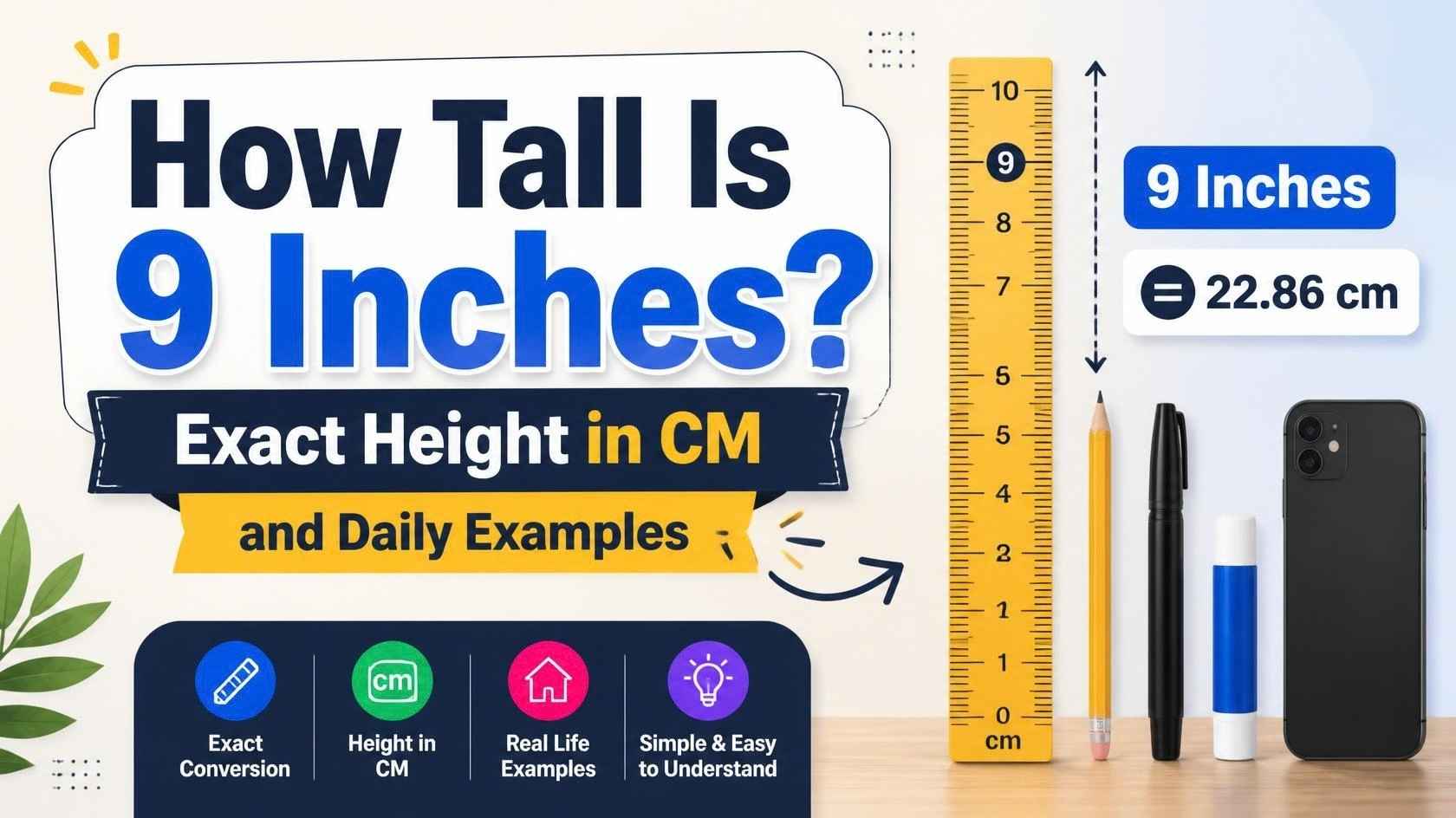
Nine inches is equal to 22.86 centimeters. It is a common measurement used for household items, electronic devices, kitchen tools, books, and many everyday products. Although nine inches may sound small, it can represent a noticeable length depending on the object you are measuring.
Understanding this measurement helps you estimate sizes without always reaching for a ruler. You can use familiar objects as references and compare their dimensions with nine inches. This skill is useful when shopping online, choosing home accessories, checking product dimensions, or completing simple DIY projects.
In this guide, you will learn how long nine inches is, how to convert it into other units, and which everyday objects can help you picture its size. You will also discover practical ways to estimate nine inches without a measuring tool.
15 Common Everyday Things That Are About 9 Inches Long
Many familiar objects have one dimension close to nine inches. Their exact sizes vary by brand, design, and intended use, so these examples should be treated as visual references rather than guaranteed measurements.
Here are 15 everyday items that may measure approximately nine inches in one direction:
- A4 paper width: A standard A4 sheet is 8.27 inches wide, making it slightly narrower than nine inches.
- Medium laptop screen height: Some compact laptops have screen dimensions approaching nine inches in height, depending on the model and orientation.
- Kitchen frying pan handle and base section: Certain small pans and their handles may span around nine inches in a particular direction.
- Small adult shoe length: Some smaller adult shoes measure near this length, although shoe size and actual length differ.
- Tablet screen height: Compact tablets may have a screen height close to nine inches.
- Small cutting board width: Some kitchen cutting boards measure around nine inches across.
- Medium wall clock diameter: A nine-inch clock is a common possible size for a medium wall clock.
- Large notebook height: Some notebooks are close to nine inches tall.
- Serving tray width: A compact serving tray may measure approximately nine inches across.
- Tall water bottle height: Some bottles approach nine inches in height.
- Laptop keyboard section: A portion of a laptop keyboard may span around nine inches.
- Hardcover book width: Certain wide books may measure close to nine inches across.
- Small baking tray: Some compact baking trays have a dimension near nine inches.
- Compact monitor screen height: Some small displays may approach this height, depending on their proportions.
- Large sub sandwich: A nine-inch sandwich is a familiar food-size reference, although menu sizes vary.
These comparisons make nine inches easier to imagine. However, always check the actual product dimensions when accuracy matters.
9 Inches in Different Units
Converting inches into other units helps you understand measurements used in different countries and product descriptions. Inches are common in the United States, while centimeters and millimeters are widely used internationally.
The exact conversions for nine inches are straightforward.
| Measurement unit | Equivalent of 9 inches |
| Centimeters | 22.86 cm |
| Millimeters | 228.6 mm |
| Feet | 0.75 ft |
| Yards | 0.25 yd |
| Meters | 0.2286 m |
| Kilometers | 0.0002286 km |
The most useful conversion to remember is that 9 inches = 22.86 centimeters. You can also round this to approximately 23 centimeters for quick estimates.
To convert inches into centimeters, multiply the number of inches by 2.54. For example, nine multiplied by 2.54 equals 22.86 centimeters.
To convert inches into millimeters, multiply by 25.4. This means nine inches equals 228.6 millimeters. For feet, divide the inch measurement by 12, giving you 0.75 feet.
What Does 9 Inches Look Like?
Nine inches is slightly longer than the width of a standard A4 sheet of paper. It is also close to 23 centimeters, which makes it easier to picture if you are familiar with the metric system.
Imagine a straight line extending from one end to the other across a small household object. If that line measures about 23 centimeters, it is close to nine inches. The comparison works best when you focus on one specific dimension, such as length, width, height, or diameter.
A useful way to visualize nine inches is to picture three equal sections, each measuring three inches. Together, these sections create a total length of nine inches. You can also imagine three consecutive 7.62-centimeter sections.
Remember that an object’s overall size may look different depending on its shape. A nine-inch circular clock has a diameter of nine inches, not a nine-inch circumference. Likewise, a nine-inch tablet measurement may refer to its screen diagonal rather than its height or width.
Why Understanding 9 Inches Matters
Knowing how long nine inches is can make everyday decisions easier. You may need to check whether an item fits on a shelf, compare the dimensions of two products, or estimate the size of a kitchen accessory.
Online shopping is one situation where this knowledge is particularly useful. Product photos can make objects appear larger or smaller than they really are. Reading the measurements and comparing them with familiar objects helps you develop a more realistic idea of the item’s size.
Accurate measurement also matters for practical projects. When arranging furniture, cutting materials, selecting containers, or installing household accessories, even a small measurement error can affect the final result.
Understanding nine inches is useful for:
- Comparing product dimensions before making a purchase.
- Estimating the size of household objects.
- Checking whether an item fits in a particular space.
- Planning simple crafts and DIY projects.
- Understanding measurements in recipes and product instructions.
- Communicating dimensions clearly with other people.
For casual estimates, familiar objects are usually enough. For construction, installation, and other tasks that require precision, use a suitable measuring tool.
15 Real-Life Examples of 9 Inches (Simple & Daily Use)
Nine inches becomes easier to understand when you compare it with objects you encounter regularly. Some items may be slightly shorter or longer, but they can still provide a useful starting point for visual estimation.
The following examples explain how each object relates to this measurement. Keep in mind that a product’s listed size may describe its length, width, height, screen diagonal, or another dimension.
1. Standard A4 Paper Width
A standard A4 sheet measures 8.27 inches wide and 11.69 inches long. Its width is therefore 0.73 inches shorter than nine inches.
This makes A4 paper a convenient reference. If you imagine the sheet’s shorter edge, nine inches would extend a little beyond it. This comparison is especially useful in offices, schools, and homes where A4 paper is readily available.
2. Medium Laptop Screen Height
Laptop screens come in many sizes. Some compact devices have display dimensions that can help you visualize a measurement near nine inches.
However, screen size is usually advertised by its diagonal measurement, not its height. A laptop with a nine-inch diagonal would not necessarily be nine inches tall. Check the manufacturer’s specifications before using a screen as an exact reference.
3. Kitchen Frying Pan Handle + Base Section
A frying pan can provide a helpful example because it has a circular base and an extended handle. Depending on the design, a small pan’s overall length may approach nine inches.
Measure from the far end of the handle to the opposite edge of the pan to determine its total length. Do not assume that every frying pan has this measurement, since pan diameters and handle lengths vary considerably.
4. Shoe Length (Average Adult Size Small)
Some smaller adult shoes may have an external length close to nine inches. However, this depends on the shoe style, size system, and manufacturer.
A shoe’s marked size does not directly equal its length in inches. Running shoes, dress shoes, and casual footwear can also differ in shape. A physical measurement is more reliable than estimating size from the label.
5. Tablet Screen Height
A compact tablet can help you picture a length close to nine inches. Some tablets are advertised with screen sizes around this value, although manufacturers usually measure screens diagonally.
The screen height and device height will be smaller than the diagonal measurement for most rectangular tablets. If you need an accurate comparison, check the full device dimensions rather than relying only on the advertised screen size.
6. Kitchen Cutting Board Width (Small)
Some small cutting boards measure approximately nine inches across. They are useful references because the measurement is easy to see and compare against other kitchen tools.
A cutting board’s width is the distance between its two side edges. Its length may be different, especially when the board is rectangular. Look at both dimensions if you are checking whether it will fit inside a drawer.
7. Wall Clock Diameter (Medium)
A wall clock with a nine-inch diameter measures nine inches from one side of its circular face to the opposite side through the center.
This is a particularly clear example of a nine-inch measurement. The diameter is not the same as the distance around the clock’s outer edge. If you are buying a clock, check whether the advertised dimension includes the frame.
8. Notebook Height (Large Size)
Some notebooks are approximately nine inches tall. This depends on the paper format, binding, and cover design.
Place the notebook upright and measure from its bottom edge to its top edge. A notebook around 23 centimeters high will be close to nine inches. This comparison can help when selecting stationery or organizing storage spaces.
9. Serving Tray Width (Medium-Large)
A serving tray may have a width close to nine inches, particularly when it is designed for snacks, cups, or small meals.
The measurement can help you estimate how much counter or table space the tray will occupy. Check the tray’s usable surface as well as its outer dimensions, since raised edges and handles can affect its overall size.
10. Water Bottle Height (Tall Size)
Some water bottles stand close to nine inches tall. However, bottle height depends on capacity, shape, lid design, and insulation.
Measure the bottle from its base to the highest point of its lid. A bottle with a wide body may hold more liquid than a slim bottle of the same height, so height alone does not determine capacity.
11. Laptop Keyboard Width Section
A laptop keyboard can provide a useful reference for part of a nine-inch span. Some keyboard layouts have a width near this measurement, while others are substantially wider.
Measure across the keyboard’s left and right edges rather than estimating from individual keys. Compact laptops and full-size laptops often have different layouts, so the comparison will not work equally well for every device.
12. Book Width (Hardcover)
Some large hardcover books measure close to nine inches wide. Art books, photo collections, and oversized reference books are more likely to approach this dimension than standard novels.
To check the width, measure horizontally across the front cover. Do not confuse width with height or spine thickness. Books with similar page counts can have very different dimensions.
13. Kitchen Baking Tray (Small)
A small baking tray may measure around nine inches across or along one side. The exact dimensions depend on its intended use and the shape of the tray.
This measurement matters when choosing bakeware for an oven or storage cabinet. Check the external width and length, as the usable cooking surface may be smaller than the tray’s overall dimensions.
14. Monitor Screen Height (Compact)
Some compact displays can help you picture a nine-inch vertical measurement. However, monitor sizes are generally advertised by the diagonal length of the visible screen.
A screen with a nine-inch diagonal will be shorter than nine inches in height. The precise height depends on the aspect ratio and bezel design. Always check the listed width and height when planning a monitor setup.
15. Sub Sandwich Length (Large Portion)
A nine-inch sub sandwich is an easy food-based reference. Its length is approximately 22.86 centimeters, making it slightly shorter than a standard foot-long measurement.
Sandwich sizes can vary by restaurant and preparation method. If you are using a sandwich to visualize nine inches, treat it as an estimate rather than a guaranteed standard size.
9 Inches in Daily Life
Nine inches appears in many ordinary situations. It may describe the width of a small object, the height of a container, or the diameter of a circular item. Learning to recognize this length helps you estimate dimensions more confidently.
In the kitchen, nine inches may be relevant when comparing trays, cutting boards, pans, and serving dishes. In an office, it can help you visualize notebooks, paper, and electronic accessories. Around the home, it can be useful when arranging shelves or choosing decorative items.
Online product listings often display measurements in both inches and centimeters. If you see a product listed as 22.86 cm long, you now know that it is exactly nine inches long. If the listing says 23 cm, the measurement is very close.
The key is to identify which dimension the seller is describing. Length, width, height, and diameter are different measurements. Understanding the difference prevents confusion when comparing products.
Visualizing 9 Inches Without a Ruler
You do not always need a ruler to estimate nine inches. A few simple techniques can help you develop a reasonable sense of this length.
Use a familiar sheet of paper. The shorter edge of standard A4 paper is 8.27 inches. Nine inches is a little longer, so the paper provides a convenient starting point.
Think in centimeters. Nine inches equals 22.86 centimeters. If you are more familiar with metric measurements, imagine a length of approximately 23 centimeters.
Divide the distance into smaller sections. Three sections of three inches each make nine inches. This method is useful when estimating a longer object in parts, although each section must be estimated carefully.
Compare with a known object. A notebook, small tray, or other familiar item can help you judge the distance. Choose an object whose dimensions you have measured before for better results.
Use your hand cautiously. Hand sizes differ from person to person. Your palm or finger span may help with rough estimates, but it should not be treated as a standard measurement.
These methods work well for everyday comparisons. If you need to cut a material, install a fitting, or check a strict size requirement, confirm the measurement with a ruler or tape measure.
Common Mistakes When Estimating 9 Inches
Estimating nine inches can be simple, but several common errors can lead to inaccurate results. The first is assuming that all objects in the same category have identical dimensions. A small bottle and a tall bottle, for example, may have very different heights.
Another mistake is confusing a screen’s diagonal measurement with its height or width. Electronic devices are often advertised by diagonal screen size. That number does not describe the length of either side.
People may also confuse diameter with circumference. The diameter of a circle is the straight-line distance across its center. The circumference is the distance around its outside edge. A circular object with a nine-inch diameter has a circumference much greater than nine inches.
Other common mistakes include:
- Guessing from a photograph without considering perspective.
- Using hand measurements without knowing their actual size.
- Confusing centimeters with inches.
- Measuring from the wrong starting point.
- Forgetting to include handles, lids, or outer frames when total dimensions matter.
- Rounding measurements too early in a precision task.
To avoid these mistakes, read product specifications carefully and identify the dimension you need. Use visual comparisons for general estimates and proper measuring tools when accuracy is important.
9 Inches Compared to Other Measurements
Comparing nine inches with other familiar measurements can make it easier to understand. It is three-quarters of a foot and one-quarter of a yard. It is also 22.86 centimeters, which is close to 23 centimeters.
The table below shows how nine inches compares with several common lengths.
| Measurement | Length in inches | Difference from 9 inches |
| 3 inches | 3 | 6 inches shorter |
| 6 inches | 6 | 3 inches shorter |
| 9 inches | 9 | Same length |
| 10 inches | 10 | 1 inch longer |
| 12 inches | 12 | 3 inches longer |
| 18 inches | 18 | 9 inches longer |
| 1 foot | 12 | 3 inches longer |
| 2 feet | 24 | 15 inches longer |
These comparisons are useful when reading product dimensions or planning a small project. For example, a 12-inch object is one-third longer than a nine-inch object. A six-inch object is two-thirds as long as nine inches.
The difference may seem small when comparing nearby measurements, but it can matter when fitting objects into limited spaces. Always compare the actual dimensions if the available space is tight.
How 9 Inches Is Used in Product Design
Product designers use measurements such as nine inches to determine how an item will fit, function, and feel. A small difference in length can affect storage, portability, comfort, and appearance.
For example, a designer creating a tray may choose dimensions that allow it to hold cups or snacks without taking up too much table space. A manufacturer designing a compact accessory may consider whether its dimensions fit standard bags, drawers, or shelves.
Designers also account for factors beyond length. Width, depth, weight, materials, and shape influence how an object performs. A nine-inch object can be narrow and lightweight or wide and bulky.
Product descriptions should therefore provide clear dimensions rather than a single measurement when possible. Buyers can use this information to decide whether an item meets their needs. Accurate specifications also help reduce misunderstandings and unnecessary returns.
Importance of Accurate Measurement
Accurate measurement helps ensure that objects fit and function as expected. It is important when purchasing furniture, selecting appliances, cutting materials, or organizing a workspace.
Even a small error can create problems. An item may fail to fit inside a drawer, a shelf may be too short, or a replacement part may not match the original. Checking dimensions before starting a task can save time and money.
For everyday activities, an estimate may be sufficient. For technical work, construction, repairs, or product installation, use a suitable ruler, measuring tape, or caliper, depending on the task.
Follow these simple practices for better accuracy:
- Start measuring at the correct zero point.
- Keep the ruler or tape straight.
- Read the measurement at eye level.
- Check whether the measurement uses inches, centimeters, or millimeters.
- Record dimensions clearly.
- Measure more than once if precision matters.
Good measurement habits reduce mistakes and make it easier to communicate sizes accurately.
Improving Measurement Skills
You can improve your ability to estimate nine inches by practicing with everyday objects. Start by choosing items such as a notebook, a cutting board, or a small box. Estimate each item’s length, then measure it with a ruler to check how close you were.
Repeat this exercise with objects of different shapes. Practice estimating horizontal lengths, vertical heights, and circular diameters. This will help you recognize that a measurement describes a specific direction rather than an object’s entire size.
It is also useful to practice conversions. Remember that one inch equals 2.54 centimeters. Multiplying inches by 2.54 gives the metric equivalent. Dividing centimeters by 2.54 converts the measurement back into inches.
With regular practice, you will become more comfortable estimating common lengths. However, visual estimation is not a replacement for accurate measuring equipment when exact dimensions are required.
FAQs
What is 9 inches in cm?
Nine inches equals 22.86 centimeters. For a quick estimate, you can round it to approximately 23 centimeters.
Is 9 inches big or small?
Nine inches is a moderate length for many household objects. It may be large for a small accessory but relatively short for a book, tray, or electronic device.
How can I measure 9 inches without a ruler?
Compare the length with a familiar object, such as the shorter edge of A4 paper, which measures 8.27 inches. This provides a rough reference, but use a proper measuring tool when precision matters.
Is 9 inches common in daily life?
Yes, nine inches can describe the dimensions of small trays, notebooks, clocks, containers, and other everyday products. The exact measurement varies by item and manufacturer.
What objects are about 9 inches long?
Some compact tablets, small cutting boards, notebooks, water bottles, and nine-inch sandwiches may provide useful comparisons. Check their actual dimensions because sizes vary.
How many millimeters are in 9 inches?
Nine inches equals 228.6 millimeters. Multiply inches by 25.4 to convert any inch measurement into millimeters.
Is 9 inches the same as three-quarters of a foot?
Yes. One foot contains 12 inches, and nine divided by 12 equals 0.75 feet. Therefore, nine inches is exactly three-quarters of a foot.
Conclusion
Nine inches equals 22.86 centimeters, 228.6 millimeters, and 0.75 feet. It is a useful everyday measurement that can describe the length, width, height, or diameter of many different objects. Familiar references, such as A4 paper, notebooks, and small household items, can help you picture this distance.
The most important point is to understand which dimension you are measuring. An object’s screen diagonal, overall height, and width are not interchangeable. Use everyday comparisons when you only need an estimate, and use a ruler or measuring tape when precision matters. With practice, recognizing a length of nine inches becomes much easier.
